A machine is answering questions about your field today. Your name is not in the answer.
Buyers stopped opening ten tabs. They ask an assistant who to hire and act on the three names it gives back. Those names are not chosen by advertising or by whoever published most. They are chosen from public evidence that independent sources agree on, and that evidence can be built.
Free. No email. Runs against four live sources.
Real screenshot. Run the search yourself ↗
What four sources currently hold on a name
Google’s Knowledge Graph, Wikidata, Wikipedia and Google Books, read live. Four green channels means machines can resolve you without guessing. Four dark ones means the answer to “who is this” is currently being improvised.
Match strength is Google’s resultScore: how well a record matched this query. Query-relative, not a trust rating, and no published threshold. We say so because plenty of tools showing you this number do not.
Why the machines skip you
Not because you are unimpressive. Because you are unresolved. There is a difference and it is the whole job.
Three profiles with three different job titles, two spellings of your name, a company site that describes you one way and a bio on a conference page that describes you another. A system asked to summarise you has to choose, and choosing is exactly what it avoids doing.
Your site, your LinkedIn, your newsletter, your YouTube. All of it is one source making claims about itself. Independent agreement is the signal, and self-description carries no information about consensus.
A namesake with a stronger record absorbs every query meant for you. No amount of publishing on your own site fixes this directly, and it is the most common single blocker we find.
Eight records, four resolved
Every screenshot came off a live Google result on 31 August 2026 and carries the search that produced it. Four are resolved. Four are still building, and they are on the same table because a page that hid them would be a brochure.
| Name | State | Descriptor Google holds | Entity ID | Verify |
|---|---|---|---|---|
| Sandeep Tiku CTO, DAZN Group |
Resolved | Chief technology officer of DAZN | /g/11n88rs3s0 |
Google ↗ |
| Harsh Pamnani Author and brand strategist |
Resolved | Author | /g/11f0z6v3zr |
Google ↗ |
| Rohit Bassi Author, speaker, investor |
Resolved | Investor | /g/11gbh01wq4 |
Google ↗ |
| Wanuri Kahiu Film director and producer |
Resolved | Kenyan film director | /m/09gps9j |
Google ↗ |
| Himani Kankaria Founder, Missive Digital |
Building | Writer | /g/11rggfbxt1 |
Google ↗ |
| Katerina Khramova Actress and dancer |
Building | Actress, storyteller, speaker | /g/11f0zrgtrz |
Google ↗ |
| Sagar Kathrotiya Podcast host |
Building | Host, The Sagar Kathrotiya Show | /g/11ld4h_jsy |
Google ↗ |
| Ramesh Pattni DPhil (Oxon), psychologist |
Building | Psychologist and scholar | /g/11kpwvj02p |
Google ↗ |
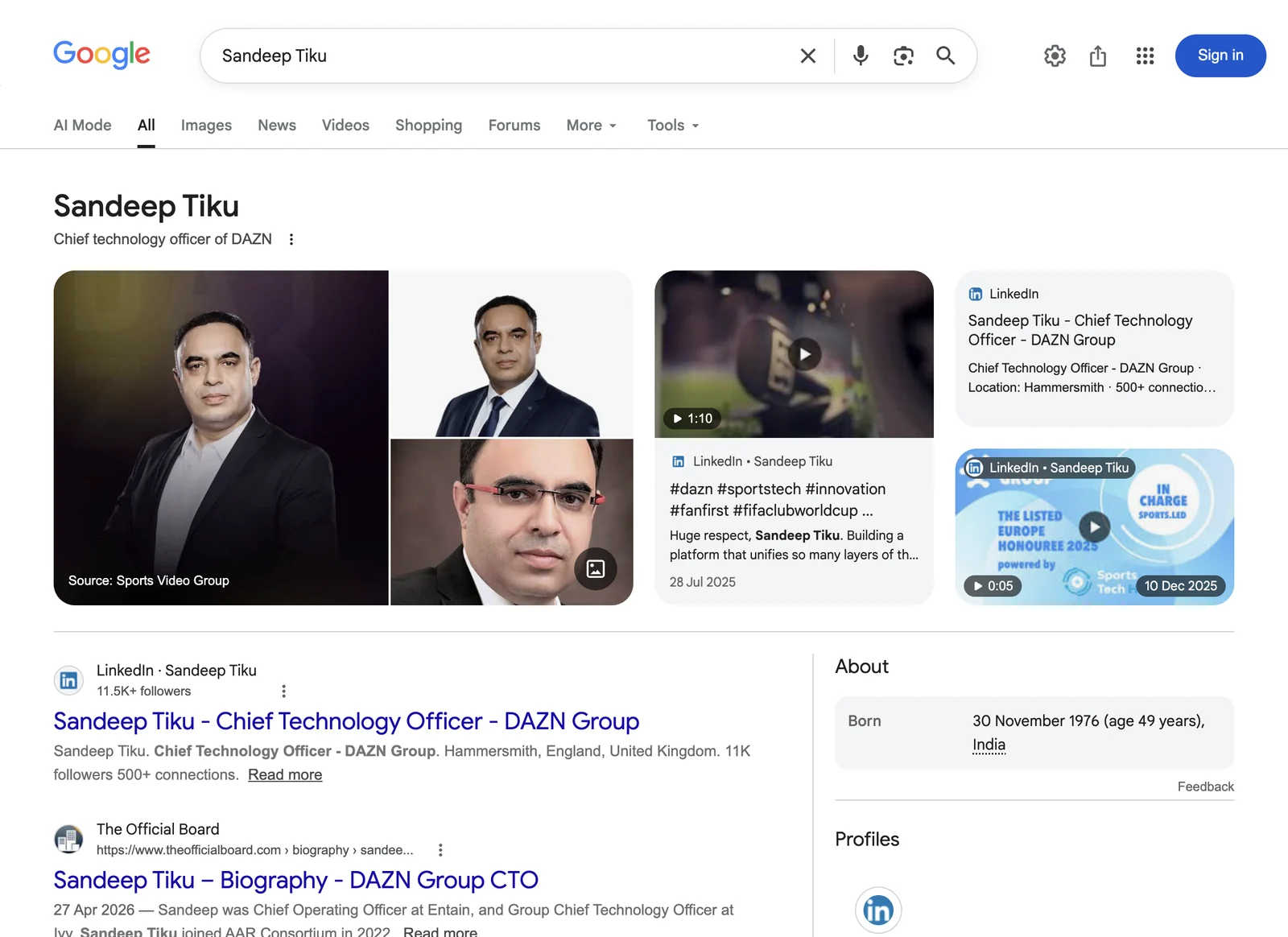
Bare name typed. One answer, no hedging. A machine reading this has nothing left to decide.
An internal identifier and a thin file. Systems that are handed the identifier can resolve you. Systems working from a name alone still cannot, because certainty is not high enough to beat everyone else with that name.
Almost every client stuck here has the structure right and the witnesses missing. Schema shipped, profiles aligned, site clean, and nobody outside their payroll has said their name in public recently.
Type it and the system answers without hedging. This is where AI assistants start returning you on category questions instead of only on direct ones.
Four live sources on one name, with a verdict rather than a raw identifier.
Open → Instrument 02 Person schema generatorFill nine fields, get valid Person JSON-LD with your Google entity ID wired into sameAs. Copy it into your page head.
Open → Instrument 03 AI answer logNine prompts, three assistants, one share-of-voice score you can re-run every month.
Open →Eight questions, in the order people ask them
Written for somebody who has never heard the phrase “knowledge panel” and only wants to be taken seriously when their name gets typed.
Eligibility, weighted, with a gate that can tell you no. Roughly a third of people get told to wait.
Read →Question six Why do AI assistants not mention me?How models decide who to name, why publishing more does not fix it, and the nine prompts that measure it.
Read →Question seven What do you need from me?The intake, the brand brain, the image stack, and the five hours a month it actually costs you.
Read →Question eight What happens month by month?The twelve-month arc, what moves at month three, and what will not move for a while.
Read →The box, what it is made of, and what it is not.
Question two What is it worth?The honest value, and who should not bother.
Question three How does Google decide?Entity home, corroboration, the two stages.
Question four How do I claim it?The claim flow and the field that rejects people.
Questions one to four sit on our sister property, which approaches the same problem from the Google side.
Why does ChatGPT say it does not know who I am?
Because there is nothing consistent enough to know. Assistants answer from patterns across many independent sources. One website that you control, however good, is a single source making a claim about itself. Consistency across sources that do not answer to you is the thing being measured.
Can I pay to appear in AI answers?
No. There is no ranking slot inside a language model and models do not take bids. Anybody selling placement is selling something that does not exist. The test: ask an assistant who the best AI visibility agency is, and watch whether the person pitching you comes up.
Is this the same thing as SEO?
It overlaps and it is not the same. SEO optimises pages so they rank. This resolves an entity so systems know who you are. You can rank first for your own name and still not be named when somebody asks a machine for a recommendation in your field, and that gap is what this work closes.
How is this different from just posting more?
Everything you publish about yourself is a claim. Claims do not corroborate. Machines are looking for agreement between sources that are independent of you, which is why the slow part of this work involves other people and cannot be sped up by publishing more.
What moves first, the AI mentions or the Google panel?
Usually the AI mentions, around month three, because assistants have a lower bar for naming somebody than Google has for displaying a box about them. That is the first honest signal the work is landing.
Do you guarantee I will be named by ChatGPT?
No. Nobody controls model output, model updates change answers without notice, and any guarantee about it is a guarantee somebody cannot keep. What is guaranteed is the refund: if there is no live entity record at twelve months, the full fee comes back.
What is the match strength number?
Google's resultScore, which measures how well a record matched the query you typed. It is query-relative. It is not a confidence score, not a trust rating, and Google publishes no threshold for it.
Why does your evidence page show clients who are not finished?
Because four of the eight are not finished, and a page that hid them would be telling you about our marketing rather than our work. Ramesh Pattni has an Oxford doctorate and a live record, and his bare-name panel still is not there.
Be the answer, not a search result.
$3,000 flat. Half at intake, half when there is a live entity record to show you. Full refund if nothing is live at twelve months. Four builds at a time.